Nicolas de Lenfent
The Vampire LestatNicolas de Lenfent is a musician and Lestat de Lioncourt’s intimate friend, whose devotion to the violin draws him away from the respectable future planned by his family and into the precarious life of a Paris theater. Their companionship grows through art and conversation, but Lestat’s sudden departure and concealment of his new existence leave Nicolas isolated. His eventual death by fire, after the Theater of the Vampires gathers for his final request, fixes music and loss together in Lestat’s memory.
Identity and Background
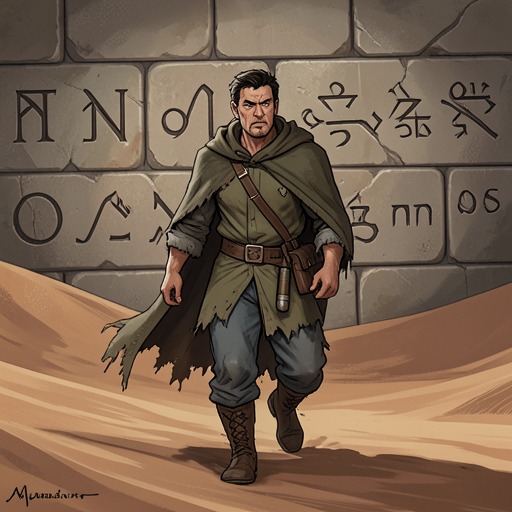
Nicolas is the eldest son of a draper from Lestat’s village in the Auvergne. Sent to school in Paris, he returns at about Lestat’s age dressed in conspicuously fine clothes: a rose-and-gold brocade coat, gold-heeled slippers, and Italian lace at the collar. His dark, curly hair, tied back with ribbon, still gives him a boyish appearance. Lestat first sees him as a striking young man, but learns that the family’s investment in making him an imitation aristocrat has collided with his own ambitions.
During his first term studying law in Paris, Nicolas falls in love with the violin after hearing an Italian virtuoso. He gives up his studies, sells his books, and devotes himself to playing; he also takes lessons from Wolfgang Mozart. He fails his examinations and wants to become a musician, to his father’s fury. His father smashes the expensive instrument, making the conflict between family expectation and artistic vocation concrete. Nicolas’s subsequent return to performance is not a return to the respectable career mapped out for him, but a commitment to music on uncertain terms.
From the Auvergne to the Paris Stage
Nicolas and Lestat begin their friendship through the exchange of questions. Nicolas asks what it was like for Lestat to kill wolves; Lestat responds by asking about Paris, the university, Mozart, and what people there think. The conversation opens a world beyond the isolated estate. When Lestat leaves the family home, Nicolas and their conversations become the center of his life outside hunting. They walk the mountain slopes, share bread and wine, explore the ruins of an old monastery, spend time in Lestat’s rooms, and sometimes return to an inn after drinking too much.
They eventually decide that Paris, even as penniless beggars, is preferable to remaining where they are. In Paris, they find work at Renaud’s House of Thesbians. Lestat throws himself into the theater’s communal life, learning and working among the actors; Nicolas, less enthusiastic about Lestat’s practical theatrical labor, nevertheless becomes a musician there. The theater is also a refuge from the limits of the city’s official culture. Serious drama is reserved to government-sanctioned houses such as the Comédie-Française and the Théâtre des Italiens, while boulevard theaters carry on popular performance. Nicolas’s violin solo, played from the small orchestra and set apart by a spotlight, becomes a distinctive feature of the evening: a brief performance that can bring the house down.
Their position in the theater also unsettles class expectations. Nicolas’s wealthy student friends regard his life there as lunacy, while Lestat’s work among actors strikes them as even less comprehensible. Lestat, for his part, drops the family name de Lioncourt and uses the simple name Lestat de Valois. The young bourgeois who look down on the theater aspire to aristocratic status, a contradiction made sharper by their later involvement in the Revolution that abolishes the class they hoped to join. Against those ambitions, Nicolas and Lestat make their lives through the theater rather than through the status their families and acquaintances expect them to pursue.
Love, Art, and Separation
Nicolas tells Lestat that he loves him, while also calling him a fool for his ideas about goodness. Their disagreement does not diminish the closeness between them. Lestat answers that he can live without God, and even with the possibility that there is no afterlife, but cannot continue without believing that goodness is possible. He asks Nicolas to explain his own beliefs rather than mock him. Their differing convictions are part of the bond: they talk not only about where to live and how to make art, but about whether goodness can exist in a world without assured meaning.
After Lestat becomes a vampire, he arranges financial help for the people he has left behind. He directs his attorney, Roget, to send Nicolas money, find him a decent flat on Saint Louis Island or somewhere similarly respectable, and buy him the best violin available, a Stradivarius. Nicolas is to be told only that the money comes from his friend Lestat de Lioncourt. The arrangement is meant to provide material security without bringing Nicolas into contact with Lestat’s changed life. Instead, the separation deprives Nicolas of the explanation and direct companionship he wants.
Nicolas does not accept the gifts as a substitute for his friend. He frightens Roget by repeatedly demanding to see Lestat, while Lestat avoids learning the location of his new home because he is wary of meeting him. Lestat hears that Nicolas remains at Renaud’s House of Thesbians, but does not go to him. When he finally watches Nicolas through an open window, he sees him at a late supper with Jeannette and Luchina, among the books, inlaid desk, and Italian violin that Lestat’s money has supplied. The objects attest to Lestat’s generosity, but they cannot answer Nicolas’s questions about why he vanished.
Nicolas rejects the explanations offered by those around him. He does not believe that Lestat has married a rich woman and is ashamed of his former companions. He remembers hearing Lestat call to him when Lestat disappeared, and insists that Lestat would never be ashamed of them. The others distrust his account, and their silence leaves him more isolated. He recognizes that Lestat sends money, but experiences the gifts as a game that offers neither an honest account nor the return of their former life. Lestat, listening to the violin from a distance, understands its language and longs for their conversation to continue. He also comes to see beauty as something not governed by a reliable distinction between good and evil: an untamed force capable of carrying people toward fatal mistakes.
Decline and Death
Nicolas’s isolation worsens. After a violent episode involving the vampires, the theater resumes performances and the crowds find ordinary explanations for the disruption, but Nicolas refuses to return either to the theater or to his music. He drinks heavily, insults Roget when the attorney visits, and wanders alone through dangerous nighttime streets. Lestat recognizes a painful likeness between them, but recognition does not repair the distance he created.
Later, Nicolas’s fellow vampires write to Lestat that their “Oldest Friend” imprisoned him in Lestat’s former residence after his excesses. Nicolas’s hands were taken from him, though the letter explains that the vampires could restore them; they were kept safe, and he was deprived of sustenance during nights of distress. At the troupe’s insistence, the Oldest Friend eventually released Nicolas and returned what had been taken. The account makes plain that Nicolas’s decline has become a crisis within the vampire theater, but his release does not restore his desire to live.
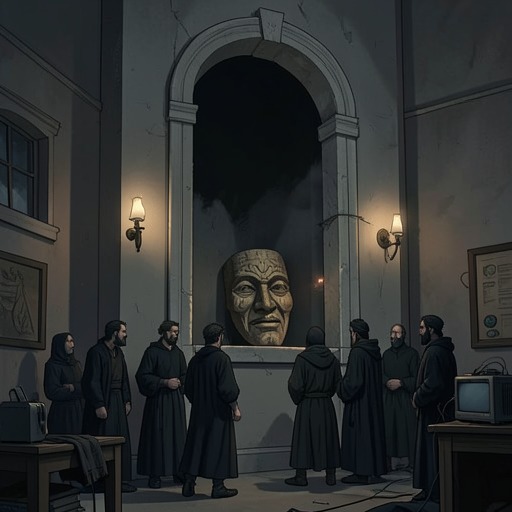
Nicolas puts his affairs in order in the manner of a mortal and leaves a stack of newly written plays to the troupe. He asks them to assemble the ancient Sabbat in the countryside and perform its customary gathering with a blaze; otherwise, he says, he will make the theater his funeral pyre. The Oldest Friend grants his wish. The troupe gathers in wigs, fine clothes, and black ruffled costumes, forms its circle, and sings the old chants. Nicolas gives Lestat’s violin to the messenger to send to its maker, then enters the flames. His death is reported as the end of his life, not as a recovery from the despair that had separated him from the theater and from Lestat.
After returning to Paris, the troupe discovers that Nicolas had arranged for the theater to be officially named the Theater of the Vampires. The name remains on its front: the public finds it amusing, and no one changes it. The theater’s new title preserves Nicolas’s mark on the company, even as his death makes that public joke inseparable from private mourning. The letter ends with the image of a pale figure in the shadows resembling the young French explorer, a final suggestion of Lestat’s grief as he receives the news.
Legacy in Lestat’s Memory
For Lestat, Nicolas remains more than the friend he failed to reach. When Lestat is wasting away and thinks of Nicolas as gone, memories of him mingle with the loss of his brothers and with the sounds of wine and applause. The recollection returns to their old question of whether their work did any good: whether eating, drinking, laughter, and being together could matter even without a larger meaning. Nicolas’s absence therefore sharpens the question that had divided them, while making their shared life in the theater an answer Lestat cannot simply discard.
Much later, Lestat opens the case containing the Stradivarius he had sent Nicolas. He does not know how to play, but believes he can imitate the motions after watching Nicolas so often. He tightens the bow and applies resin as he had seen Nicolas do. The violin had once been too painful for him even to touch; now he carries it toward the secret stairs and the vampires below, moved by a desire he associates with Nicolas. The instrument does not bring their conversation back, but it gives Lestat a physical way to approach its memory.
Lestat later compares Louis, the young planter he loves in the colony, to Nicolas. Both have a grim intensity, rebelliousness, and a tortured capacity both to believe and not to believe, ending in despair. The likeness does not make the relationships identical: Lestat says Louis gains a hold over him more powerful than Nicolas ever had. But the comparison shows how decisively Nicolas has shaped Lestat’s understanding of intimacy. His music, arguments about goodness, refusal to accept gifts in place of truth, and death remain bound together in Lestat’s remembrance of a friendship that began in conversation and ended without reconciliation.